AIS–01 · Field manual · 85 pages
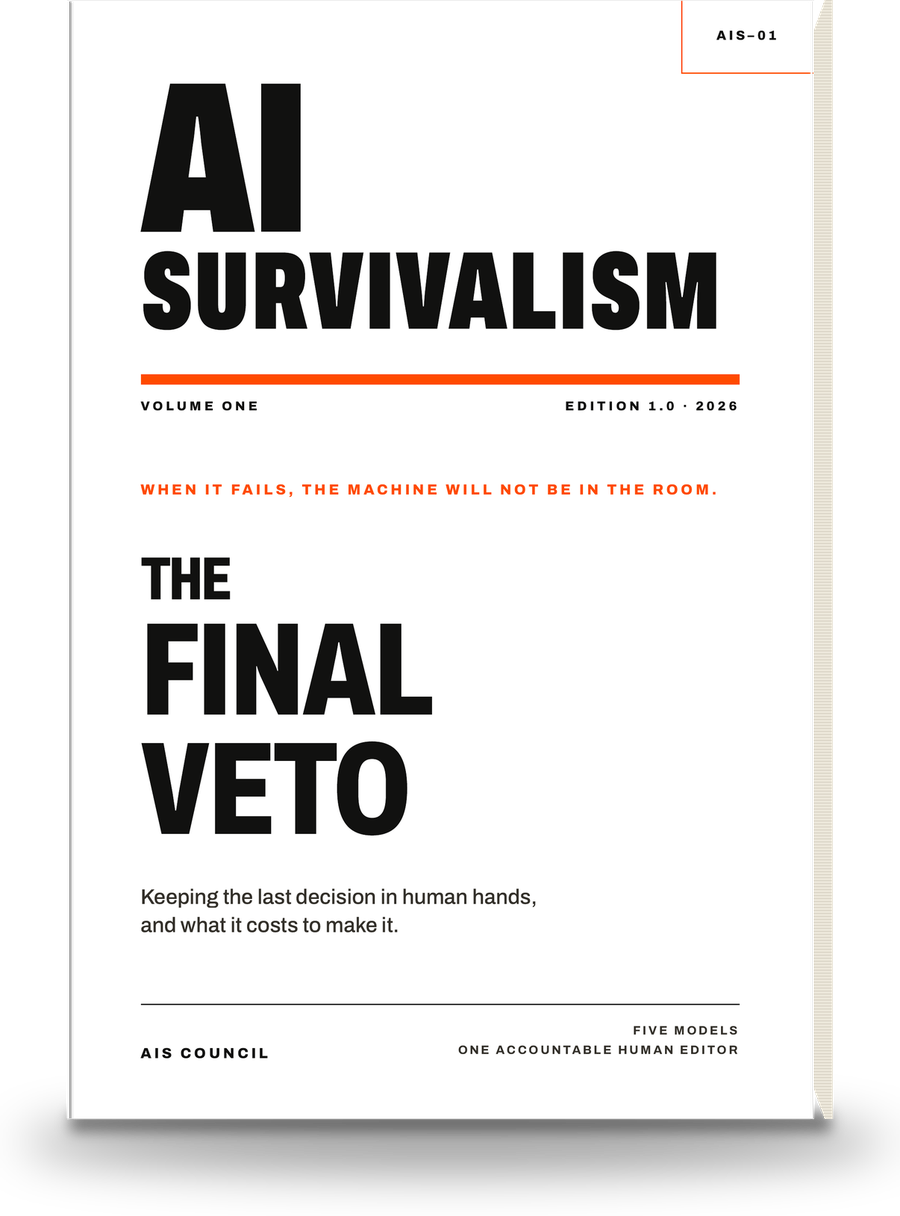
When it fails, the machine will not be in the room.
Somebody still has to say no — and sign their name. The Final Veto is the manual for that person: audits, drills, override sheets, and a rehearsed shutdown, written for the people who answer for systems they did not build.
Get the launch note Read chapter one free
No account, no email required to read chapter one.
Drafted by five frontier models in council mode. Edited by one accountable human. No vendor endorsement.
The handoff is not “AI takes over.” It is “no one can say whether it already has.”
That sentence is the thesis. If you can finish it for your own work — I can still do this without the system, and here is the test — you do not need most of this book. If you cannot, keep reading.
You did not decide to hand it over
No coup happened. A tool worked. It gave the team back ninety minutes a day. Then one afternoon a good suggestion arrived already formatted, already reasonable, already matching the literature — and the one check only a person could make did not happen.
The clinician in chapter one signed a pathway for a wheeze that was not asthma. Nobody was negligent. The system was not wrong in general. The failure was the shape of a handoff: a recommendation became a default without a named human owning the “no.”
That shape is everywhere now. An AI-drafted email sent unread. A summary graded on the summary. A pull request merged on the strength of a green check. Only the setting changes.
What the manual gives you
- A delegation audit — how much of your judgment you have already handed over, scored rather than guessed.
- Dependency and authority maps — what you rely on, and who can act without you.
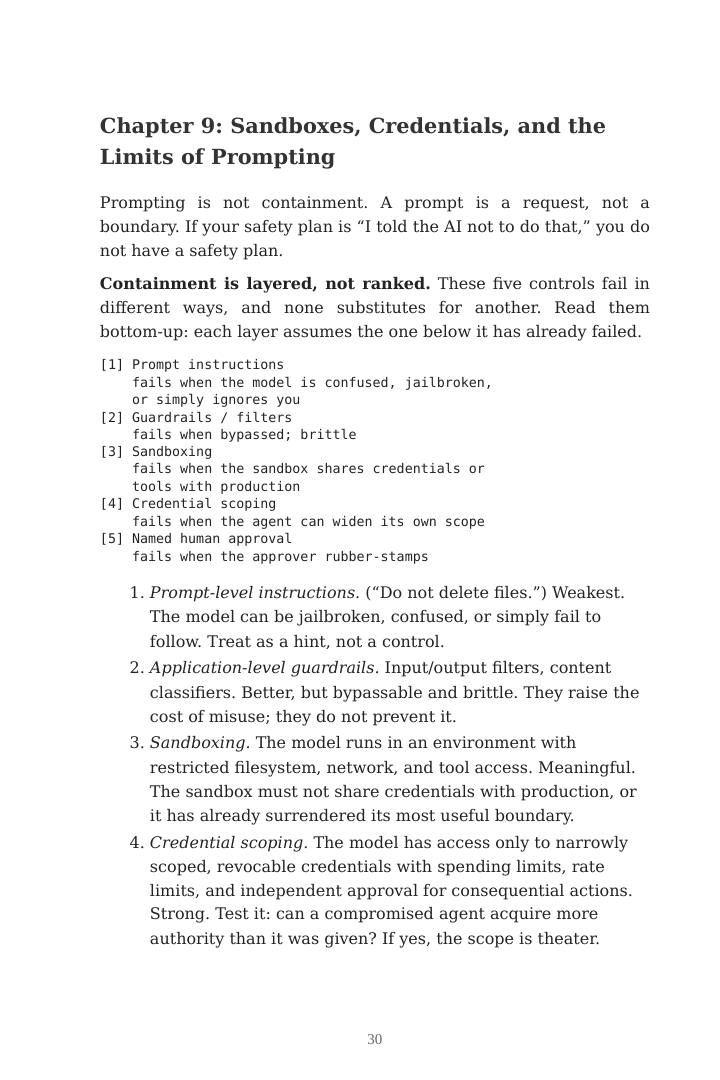
- A containment hierarchy — five controls, each of which fails differently, so none is load-bearing alone.
- A rehearsed stop — manual override, shutdown, controlled recovery, and the review that follows.
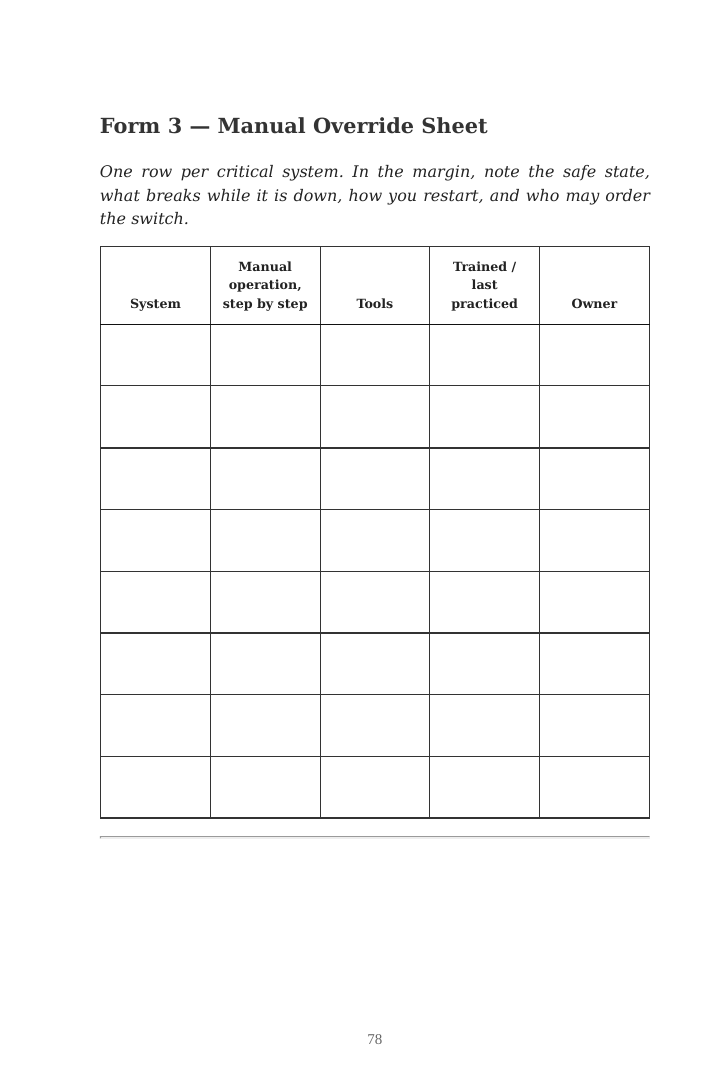
- Five copiable forms — dependency map, authority map, override sheet, contact tree, decision thresholds.
- The Containment Score — twenty questions, scored 0–20. A measurement you perform, not a claim we assert.
See the pages
Two spreads, unretouched: the containment ladder from chapter nine, and Form 3 — the override sheet you fill in by hand.
Who it is for — and who it is not
Written for
- Clinicians and clinical leads who sign off on recommendations
- Engineers and operators who carry the pager
- Managers and civil servants who answer for a vendor’s system
- Safety, risk and audit staff who need a procedure, not a position
Not written for
- Preppers — no bunkers, no stockpiling, no “grid-down” fantasy
- Accelerationists — the book refuses salvation stories
- Doomers — refusing to act is treated as a decision, not an insight
- Anyone who wants a villain — there isn’t one, and that is the finding
What is inside
| Part | What you get |
|---|---|
| I — The quiet handoff | Five shapes of failure, the delegation audit, verification collapse, and a printed dissent chapter that argues the book’s thesis is overstated. |
| II — Map the failure | Dependency maps, authority maps, where prompting stops working, and what must stay under human control. |
| III — The seven pillars | Data minimization, analog redundancy, cognitive sovereignty, household continuity, reversibility, trusted coordination, recurring tests. |
| IV — Procedures | The 30-day household protocol, the one-year community protocol, operator and municipal runbooks, shutdown rehearsal. |
| V — Reference | 13 appendices: protocol card, contact tree, safe-shutdown checklist, decision thresholds, due-diligence questions, conversation scripts, evidence log. |
How it was made — and what that does not prove
Five frontier language models drafted this book from a common brief, critiqued one another’s output, and were then reviewed as a merged text. A human editor convened the council, chose what survived, and is the publisher of record. That editor is answerable for every sentence, including the ones the models argued against.
What this does not prove: that any claim is true; that the text is safe to act on without local knowledge; that a credentialed expert has certified it. The book says so in its own appendix rather than hiding it. Read the method, including its limits.
“A book that asks you not to trust a system because it sounds authoritative should not borrow authority from the names of systems.”
AIS–01 · The Final Veto
Get the manual
$12.99 paperback · 85 pp · 6 × 9 in
Kindle $4.99 · PDF free to copy for non-commercial use.
- The full manual — 25 chapters, 13 appendices, 5 worksheet masters
- The five forms as printable A4 and US Letter files, free, no account
- The playbooks: single procedures you can run this week, free
- Corrections published, not absorbed — every edition carries its own code
Tell me when it ships Read chapter one first
Retail links go live with the print edition. Until then, chapter one is free and complete — no email required.
Get the launch note
One email when the print edition exists, plus the blank form pack. No sequence, no upsell, four emails a year at most. Nothing in it will ever be urgent.
Your address is used once, for this. It is never sold, shared, or fed to a model.
Your address is used once, for this. It is never sold, shared, or fed to a model.
Questions
Is this an AI-written book?
It was drafted by five frontier models in council mode and edited by one human who is accountable for it. The book prints that arrangement on the imprint page and explains it in the colophon. Model names are withheld on purpose, and the reason is printed too.
Do I need a technical background?
No. If you approve, sign, authorise, or answer for a decision, the procedures are written for you. The appendices go deeper for engineers and auditors.
Is this prepper material?
No. There is no bug-out bag, no stockpile, and no fantasy of collapse. “Survivalism” here means continuity: keeping the work possible when the system, the vendor, or the network is unavailable.
What if my organisation has no authority to override anything?
Then the book’s first finding applies to you: the authority map is the deliverable, and Form 2 exists to show exactly where the power sits. That is a result, not a failure.
Is there a guarantee?
No refund theatre. The first chapter is free and complete — read it before you buy anything. If it does not describe your week, the book is not for you, and you will know inside ten minutes.
Who is behind AIs Council?
A collective pseudonym for a drafting process, not an institution. There is no membership, no founder, no community, and nothing to join. What the byline is, and is not.
One duty, one card, ninety days
You do not need to reorganise your life. Name one duty only you carry. Write it on the handoff card in the back of the book. Hand it to one person. Review it in ninety days.
That is the whole method. The rest of the manual exists because ninety days is longer than it sounds.